
Saint Anne in 2026: Feast Days, Her Story, and a Bead Embroidery Pattern
Look up Saint Anne's feast day and you will find two dates one day apart. Eastern churches keep the Dormition of Righteous Anna, the mother of the Virgin Mary, on July 25 — in 2026 a Saturday. Roman Catholics and many other Western Christians honor Saints Joachim and Anne together on July 26, a Sunday. In Ukrainian sources a third date appears as well: August 7, which is how the Eastern July 25 feast falls for parishes still using the old Julian calendar.
The name itself is a second source of confusion. Several saints are called Anna, so it is worth stating plainly: all three dates above belong to Righteous Anna, the mother of the Virgin Mary and grandmother of Jesus. The T3-33 bead embroidery pattern in Povitrulya's range, despite its general "Saint Anne" title, depicts a different saint — Saint Anna of Kashin.
Saint Anne's feast days in 2026
| Tradition | Date in 2026 | Day of the week | Commemoration |
|---|---|---|---|
| New calendar (OCU and UGCC) | July 25 | Saturday | The Dormition of Righteous Anne, mother of the Most Holy Theotokos |
| Old (Julian) calendar | August 7 | Friday | The same Dormition of Righteous Anne — July 25 according to the Julian calendar |
| Western (Roman Catholic) tradition | July 26 | Sunday | The joint commemoration of Saints Joachim and Anne |
"Dormition" is the Eastern name for the commemoration of a peaceful death — literally a "falling asleep." So July 25 marks the end of Anna's earthly life. Whether a particular Anna celebrates her name day on one of these dates depends on her patron saint and her parish calendar, so the table is a map rather than a rule.
One Eastern feast, two calendars — and a separate Western memorial
The July 25 / August 7 pair is a calendar story, not a disagreement about the saint. Until September 2023, most Ukrainian parishes used the Julian calendar, which currently runs thirteen days behind the civil one. When the Orthodox Church of Ukraine and the Ukrainian Greek Catholic Church switched to the Revised Julian calendar, fixed feasts moved to their historical civil dates, and the Dormition of Righteous Anna now falls on July 25. Parishes that kept the old calendar still celebrate the liturgical July 25 — it simply lands on August 7 in today's civil calendar. One feast, two ways of writing the date.
July 26 is a different case. The Western church honors Joachim and Anne, the parents of the Virgin Mary, with a joint memorial on that day. The one-day gap between the Eastern and Western dates is a coincidence of two calendars developing separately — not the thirteen-day Julian offset, and not a "translation" of the Eastern feast.
The Eastern calendar remembers the same Saint Anne at other points of the year too: September 9, the day after the Nativity of the Theotokos (the Eastern title of the Virgin Mary), honors Joachim and Anna together, and December 9 marks the Conception of the Theotokos by Saint Anna. For old-calendar parishes these fall on September 22 and December 22. They are chapters of one story rather than extra feast days to memorize.
Who was Saint Anne?
The Church honors Anna as the mother of the Virgin Mary, the wife of Righteous Joachim and, through her daughter, the grandmother of Jesus Christ. That last title is what makes her figure so approachable: in the Gospel story she occupies a place every family knows — the grandmother's.
Honesty about sources matters here. The New Testament never names Mary's parents and tells nothing of their lives. The names of Joachim and Anna, and the familiar account of their story, come from church tradition and early non-canonical writings, above all the Protoevangelium of James.
According to that tradition, the couple remained childless for many years and grieved over it. Joachim and Anna promised in prayer to dedicate their future child to God, and an angel brought them word that a daughter would be born. They named her Mary. Two Eastern feasts — the Nativity of the Theotokos and her Entry into the Temple — grow out of this account.
Liturgical texts call Joachim and Anna the Ancestors of God, Christ's forebears in the flesh. The title explains why the calendar keeps their commemorations close to the feasts of Mary rather than on their own.
Luke's Gospel mentions another Anna, the prophetess who recognized the infant Jesus as the Messiah (Luke 2:36–38). She is a different woman with a different story — which is exactly why a shared first name is not enough when you are choosing a patron-saint icon.
What the name Anna means
The name Anna came into European languages through Greek and Latin from the Hebrew name Hannah, associated with "favor" and "grace." It is one of the most widespread women's names in the Christian world — which is exactly why the calendar holds more than one Saint Anna. The etymology makes a nice line in a greeting card, but a gift is still chosen for a particular person, not for a dictionary entry.
How to read the image
Icons of Righteous Anna, Mary's mother, are usually recognized by their subject: she holds the young Mary in her arms, stands beside Joachim, or meets him at the Golden Gate of Jerusalem. Solo images exist as well — an older woman in a veil.
The T3-33 pattern stands apart from that group: the saint on it is not Mary's mother but Saint Anna of Kashin, a princess of Tver who entered monastic life after she was widowed.
She has a calendar of her own. Church sources give July 21 for the finding of her relics in 1649, June 12 for their translation and the restoration of her veneration, and October 2 for her repose. Parishes on the old calendar keep those days on August 3, June 25, and October 15 by civil reckoning. None of them coincides with July 25, so the calendar section at the top of this article does not describe the saint on the pattern.
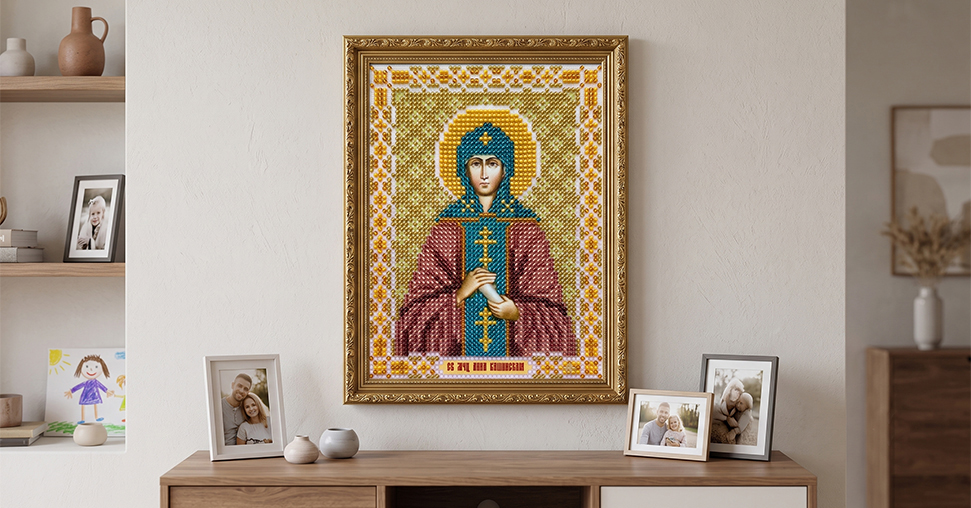
The design shows the saint half-length, facing the viewer. A golden halo surrounds her head; she wears a dark turquoise-blue head covering with small gold crosses and, over it, an outer garment in a dusty-rose shade. Her hands are crossed at her chest. The background is pale olive, the composition is framed by an ornamental border in pink, cream, and gold, and an inscription with the saint's name runs along the bottom.
The colors are the pattern designer's choices, not a theological code, so there is no hidden symbolism to decode in them.
The T3-33 pattern: what you actually receive
T3-33 "Saint Anne" is a bead embroidery pattern of Anna of Kashin, not a finished icon. The design is printed in color on A5-size gabardine fabric, with the list of colors and required bead quantities printed below the image. The pattern is designed for PRECIOSA No. 10 Czech beads.
The product does not have beads as included.
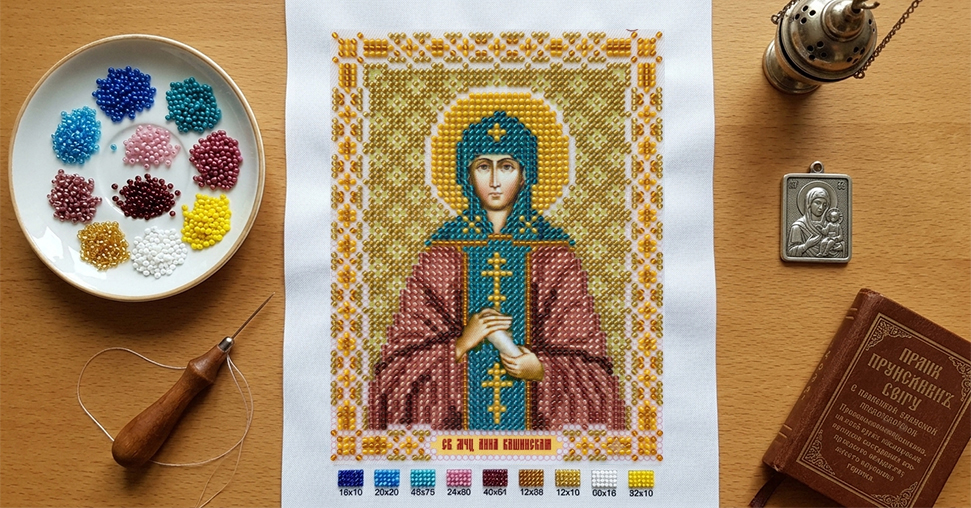
See the photos, format, and fabric on the Saint Anne bead embroidery pattern T3-33 page at Povitrulya.
A gift that crosses generations
The most precise recipient is a woman named Anna whose patron saint is Anna of Kashin, or an embroiderer deliberately looking for her image. A name day, a birthday, or a baptism can all be the occasion — though in many families the reason is simpler: someone loves needlework and someone loves her.
There is a quieter side to a gift like this. Because Joachim and Anne are honored as Jesus's grandparents, their Western feast day has naturally become an occasion to think of grandparents in general. Embroidery fits that mood: it is one of the few crafts still passed from hand to hand, a grandmother showing a granddaughter her first stitch, a mother helping read the rows of a pattern. A beaded icon made together keeps more than the saint's image — it keeps the hours spent side by side.
What such a gift does not carry is guarantees. A hand-embroidered image is not a charm and promises no miracles; its worth is the time and attention invested in it.
More named icons are gathered in the religious bead embroidery patterns category. And if you are still working out which saint is the right patron, start with the guide to finding a patron saint and name icon by birth date.
One practical step before buying: find out which Saint Anna is the patron of the Anna in your life. In 2026 you can congratulate her on July 25 or August 7, depending on her parish calendar — or on July 26 in the Western tradition. And T3-33 is the right choice when the image you want is Anna of Kashin.